



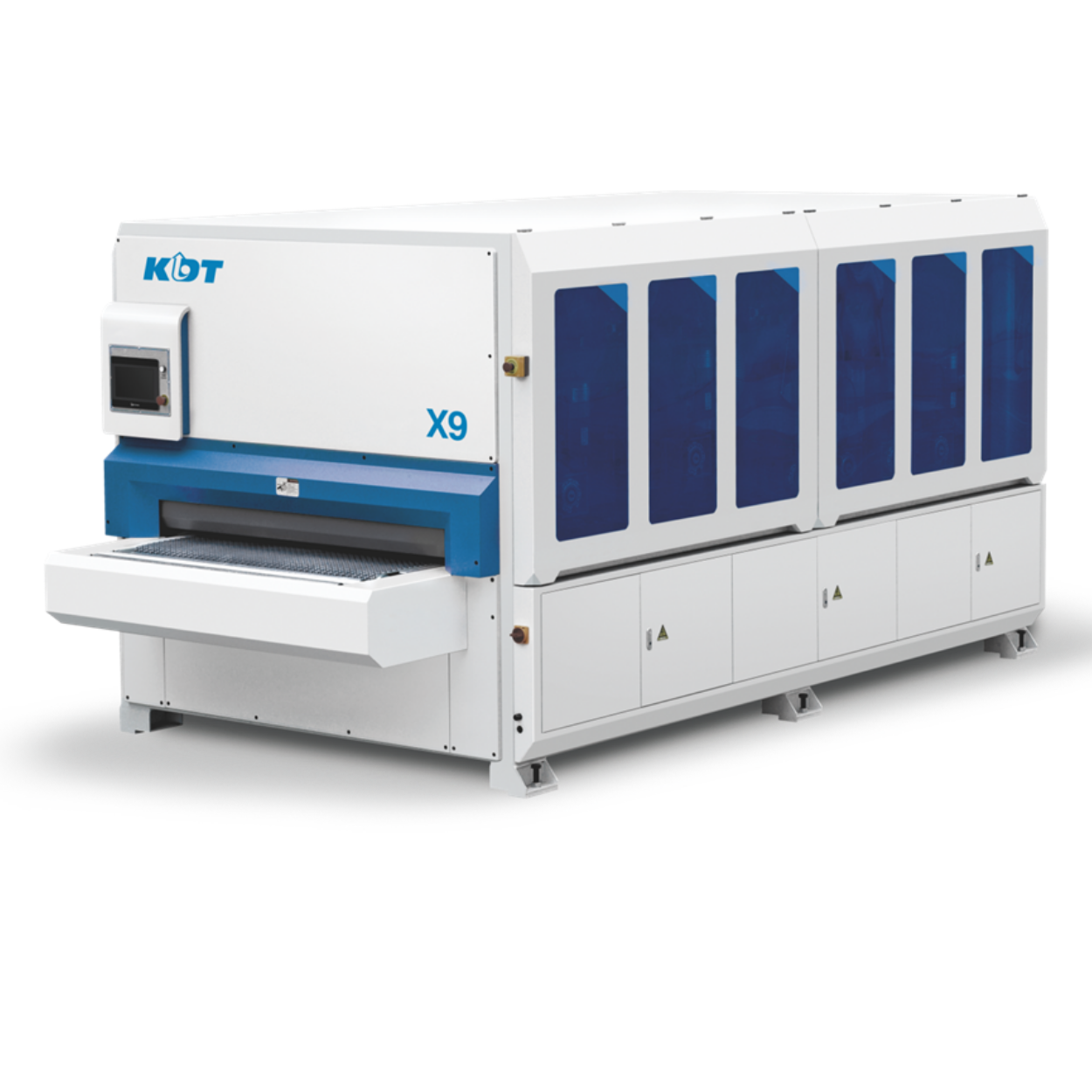

Technical Features
| Model | PX9-1300 |
| Grinding width (mm) | 10 – 1 300 |
| Part thickness (mm) | 8 – 120 |
| Minimum part length (mm) | 320 |
| Feeding speed (m/min) | 3 – 12 |
| Total power (kW) | 19 |
| Compressed air consumption (m³/min) | 0,1 |
| Aspiration (m³/hour) | 20.000 |
| Machine dimensions (mm) | 5 100×2 280×2180 |
| Machine weight (kg) | 5 100 |
Machine Video
General Features
4 Sanding Units

8 independent work units
Vertical Sanding Disc (V2)

Sanding the surface of the plate, sanding the inner groove with the carved pattern.
Cross-Abrasive Group (H2)

Sanding the transverse groove creates a sharp angle, forming a small circle at the corner after sanding; this allows for painting and prevents the corner from being easily damaged afterwards.
Screw Thread Longitudinal Abrasive Group (R2)

Longitudinal groove sanding, handling most grits, the inside of the groove can be sanded better to increase the cutting power of the sandpaper. The abrasive wire can be increased in smaller grooves.
Screw Thread Longitudinal Abrasive Group (R2)

Longitudinal groove sanding handles most grits; straight-line sandpaper is used to cover sanding marks left from pre-treatment.
Straight Line Longitudinal Sanding Group (Q2)

A dusting brush is used to sweep up the dust, which is then vacuumed away. A rotating blowing method is used to blow away the dust, which is then vacuumed away. A combination of both methods provides the best dust removal effect.
Highlights
Automatic Conveyor Belt Position Correction

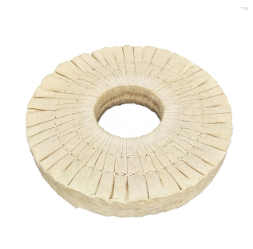
Dusting Brush


 English
  Türkçe